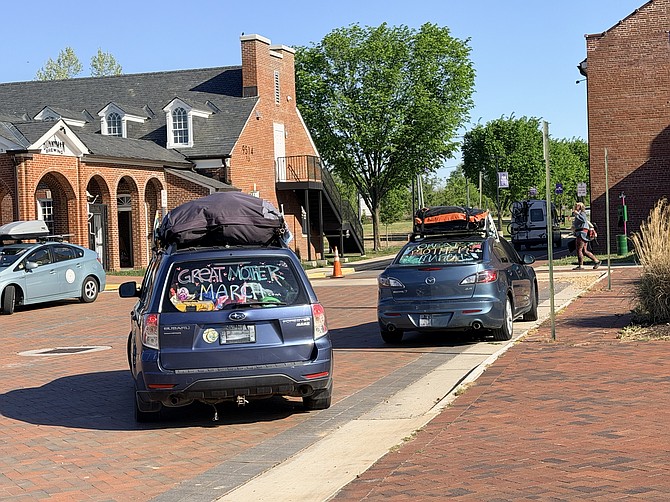
Fully packed cars provided rides for walkers and transported camping gear
Along with protests and marches, it seems pilgrimages have re-surfaced recently to promote interest, capture social media followers, and grow participation in spiritualism and causes.
In February, a group of Buddhist monks on their Walk for Peace, a 120-day, 2,300 mile, walking pilgrimage from Texas to Washington D.C. caught national and local attention. Through tragedy, hardship and poor winter weather conditions, the monks persevered to share their message of peace and mindfulness. In late April, another group of spiritualists reached our area on their 500-mile walk which started in March, from Asheville NC to Washington D.C. “The Great Mother March, A Women’s Empowerment Pilgrimage” sought to “reweave the human and earth connection.” Their effort culminated in Washington after 32 days; arriving on Earth Day, April 22.
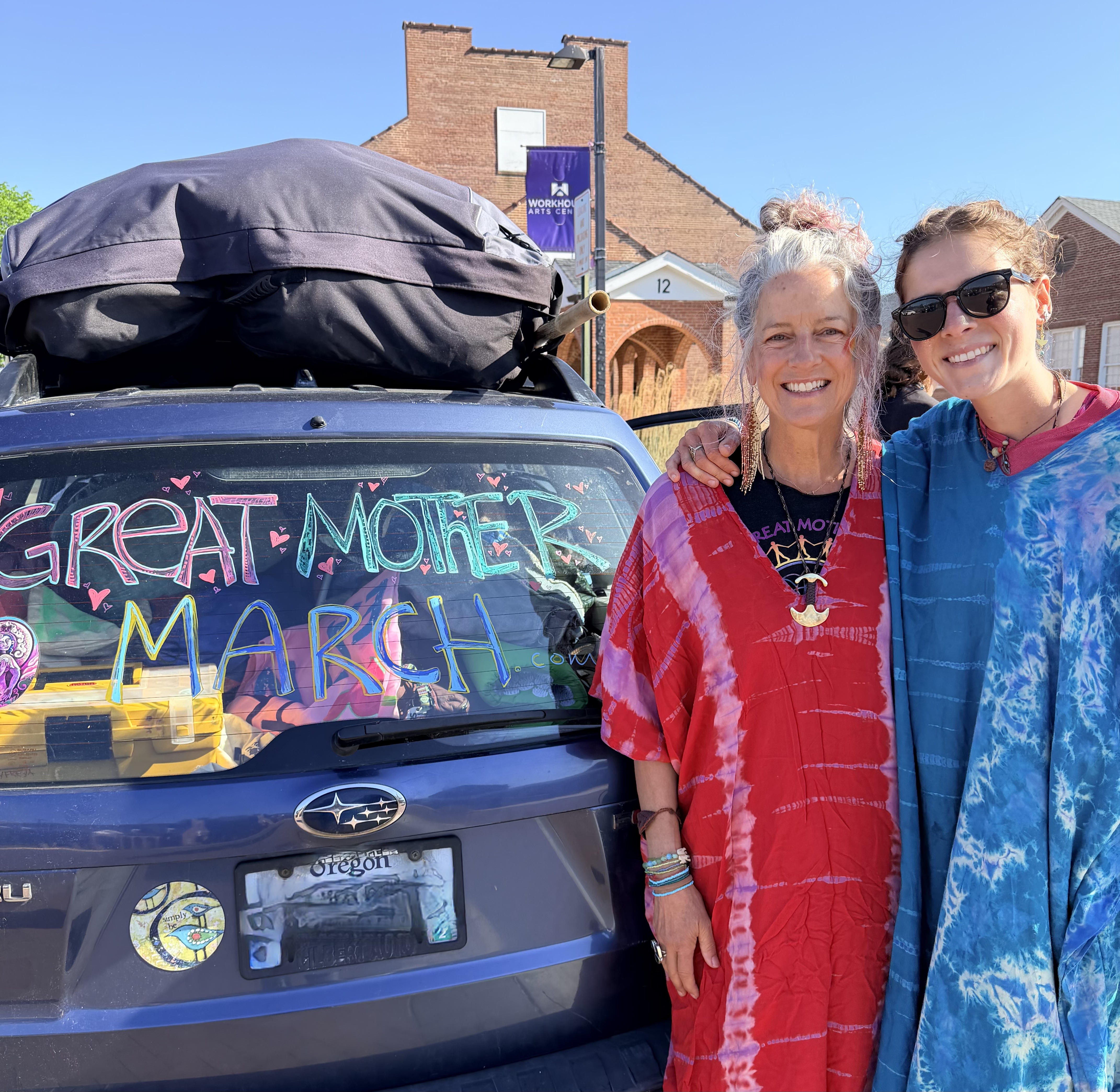 Whitney Freya, organizer/leader of the Great Mother March, with her daughter Riley Ferre
Not thought of as a center of mysticism, both groups did find Lorton a convenient stop on their journeys. The Monks took their lunch break at the Hoa Nghiem Pagoda on Feb. 8; and the Mother’s March was hosted by the Workhouse Arts Center for the evening of April 20. The women’s pilgrimage had walkers start, join and leave; coming and going as energy and weather dictate for each individual. While many take rest days, three core pilgrims, ranging in age from 22 to 68, walked, or sometimes skipped, most of the distance since the start, traveling up to 27 miles per day.
The participants gathered from many locations across the country. Friendly and free-spirited, several are life coaches and artists who emphasize creative spirit. The Arts Center was a perfect fit for the travelers, who continued work on their community art canvas project, their typical evening activity.
One pilgrim, Megan Keeliher of New Hampshire, describes herself as a life coach, doula, and practitioner of Ayurveda: a traditional Indian medicine system emphasizing diet, herbal remedies and lifestyle. She sees art as “sacred; with the use of art to heal, and as a philosophy of finding a better way.” At the Arts Center, they also took an opportunity to practice their “flash dance” choreography. About two dozen women participated in the dance at the side of the Tidal Basin in Washington DC, their final destination.
Whitney Freya of Oregon, the organizer and leader of the pilgrimage said, “We don’t expect an instant change [from problems faced today]. But it’s about a way to meet this needed change, modeling step by step, face to face interactions. We’ve been manipulated into believing we are our own enemies. That doesn’t do us any good. People we met share mutual respect … . We’ve been handing out hearts, lightening up the atmosphere.”
For more on the group, see www.greatmothermarch.com
Once prominent as described in the histories of ancient civilizations such as Mesopotamia, Egypt, and India, pilgrimages were made by people of several cultures and religions to show religious or spiritual devotion or as a demonstration of respect or dedication. In modern times, we often hear of pilgrimages taken to holy sites, such as Mecca or Jerusalem.
Recently, our area has become a last way-stop for those on journeys to Washington D.C.